
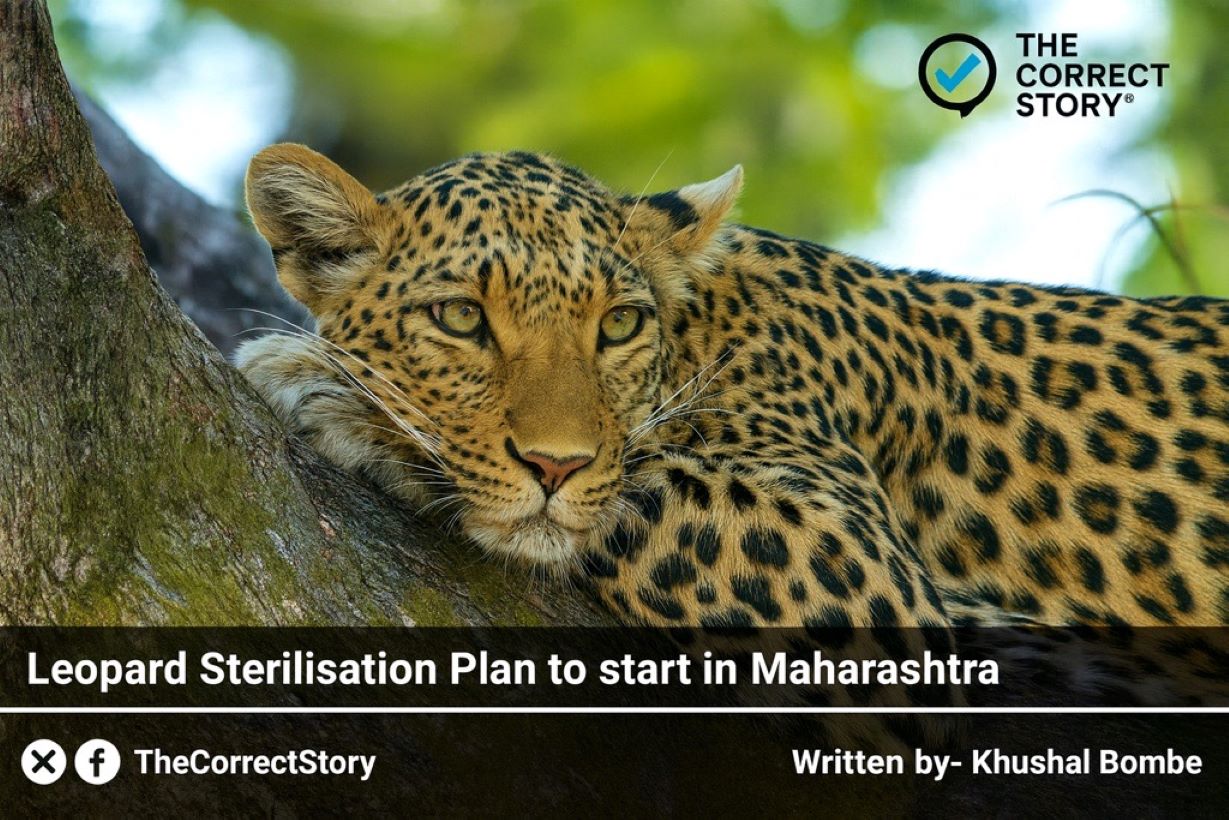
Rising Leopard Attacks in Rural Maharashtra Push State Towards India’s First Leopard Sterilisation Plan
With rising attacks and mounting fear in Maharashtra’s villages, the government is turning to an unprecedented solution — India’s first leopard sterilisation project. Will this scientific experiment ease human-wildlife conflict, or raise new questions about coexistence?
Rising Leopard Attacks in Rural Maharashtra Push State Towards India’s First Leopard Sterilisation Plan
Rural Maharashtra has been witnessing an alarming increase in leopard sightings, attacks, and human–wildlife encounters over the past few years. Several villages located near forest fringes and sugarcane belts have slowly turned into high-conflict zones. For farmers, children, and daily wage workers, life has taken an unexpected turn: routine activities like walking to school, working in the fields, or grazing cattle are now shadowed by constant fear.
Amid rising human casualties, livestock losses, and growing public panic over frequent leopard encounters in villages such as Pimparkhed, the Maharashtra Forest Department — with support from wildlife experts and after approval from MoEFCC has launched India’s first-ever trial of a leopard sterilisation / birth-control programme in the Junnar forest division.
This decision marks a significant shift in India’s wildlife conservation strategy, signalling that traditional methods are no longer enough to manage the escalating conflict.
Why Has Leopard–Human Conflict Increased So Rapidly?
Areas like the Junnar Forest Division in Pune district have become hotspots of frequent leopard encounters. Over the years, shrinking forest cover, expanding human settlements, sugarcane fields, and abundant livestock have created ideal conditions for leopards to thrive close to human habitation.
Sugarcane plantations in particular provide the perfect cover for leopards to rest and raise cubs. Easy prey such as goats, dogs, and poultry further encourages them to stay near villages.
As a result, many serious attacks — including fatal incidents involving farmers, women, young boys, and even toddlers have shaken rural communities. Villagers now remain alert at all hours. Children avoid walking alone, evening routines have changed, and some villages even enforce unofficial “stay-indoors after dark” rules.
Traditional measures such as cages, relocation, and rescue operations are proving inadequate. When one leopard is trapped and moved, another often fills the vacant territory. The conflict then continues — unresolved and recurring.
India’s First Leopard Sterilisation Project: A New Approach
In a groundbreaking move, Maharashtra will begin a pilot sterilisation/birth-control programme for leopards — the first initiative of its kind in India.
What the project aims to do
- Sterilise or administer immuno-contraceptive treatment to a controlled group of five adult female leopards in the first phase.
- Monitor and track these leopards via collars and tags.
- Slow down the rate of population growth in high-conflict zones.
- Reduce attacks, livestock killings, and fear-driven disruptions to daily life.
- Move away from short-term fixes toward long-term conflict mitigation.
The Wildlife Institute of India (WII) has conducted a multi-year field study in Junnar using camera-traps and spatial analysis to monitor leopard population density, movement, and habitat use in human-dominated and agricultural landscapes, and to identify conflict-hotspots. These findings have provided the scientific basis for recent population-management proposals in the region.
However, Sterilisation Alone Won’t Solve Everything
Experts warn that the problem is complex. Sterilisation is one step — not a complete solution.
Unless rural landscapes are better planned, livestock is protected, waste management improves, and farmers adopt safer practices, leopards will continue moving into human zones.
Other necessary efforts include:
- Strengthening rescue centres
- Improving night-time patrolling
- Setting up early-warning systems
- Educating villagers on precautions
- Protecting children and elderly during high-risk hours
- Scientific land-use planning
- Better coordination between forest officials and local communities
If these parallel measures do not progress, sterilisation alone will only delay — not eliminate — recurring conflict.
Human Lives, Livelihoods, and Fear: A Reality That Cannot Be Ignored
The emotional and psychological toll on rural Maharashtrian communities is immense.
Parents fear sending their children to school. Playgrounds remain empty. Farmers hesitate to step out early in the morning or late evening — crucial hours for crop work. Cattle rearing has become dangerous and several families have lost their only income source after livestock attacks.
Many villagers say the situation has fundamentally changed the way they live, work, and move around their own land. Everyday life that once felt safe has now become tense and unpredictable.
Will This New Project Bring Lasting Change?
If implemented responsibly, Maharashtra’s leopard sterilisation plan could become a pioneering model for India — showcasing how science, community participation, and long-term planning can reduce conflict sustainably.
But the challenge is long and complex. This is not a quick fix. It demands patience, coordination, and continuous monitoring.
If sterilisation is combined with better village-level safety measures, stronger wildlife management systems, and deeper public awareness, Maharashtra may finally move toward a more balanced coexistence between humans and leopards.
Otherwise, the cycle will repeat — more attacks, more fear, more temporary solutions.
For now, this initiative offers hope: a chance to break the pattern and protect both human lives and India’s magnificent but increasingly misunderstood leopards.


